My love of puppets started when I was in 5th grade. My church started a puppet program for the older elementary kids while our parents were in church choir practice. Every week we practiced hand-strengthening exercises (such as squeezing tennis balls) and endurance exercises (holding our arms above our heads in preparation for the puppet theater). I did not realize I was good at puppets until we had auditions for characters for our puppet musical for Daniel in the Lion’s Den. I guess my puppetry was precise and expressive enough, that I was cast as the narrator. I remember during our performance that my little 11-year-old arms were getting so tired that I often switched out my arms in the middle of songs to give my other arm a break (often making my puppet droop in the process). I had a fun time in our puppet program and it wasn’t until I started student teaching in general elementary did I think of how to use puppets in the music classroom.
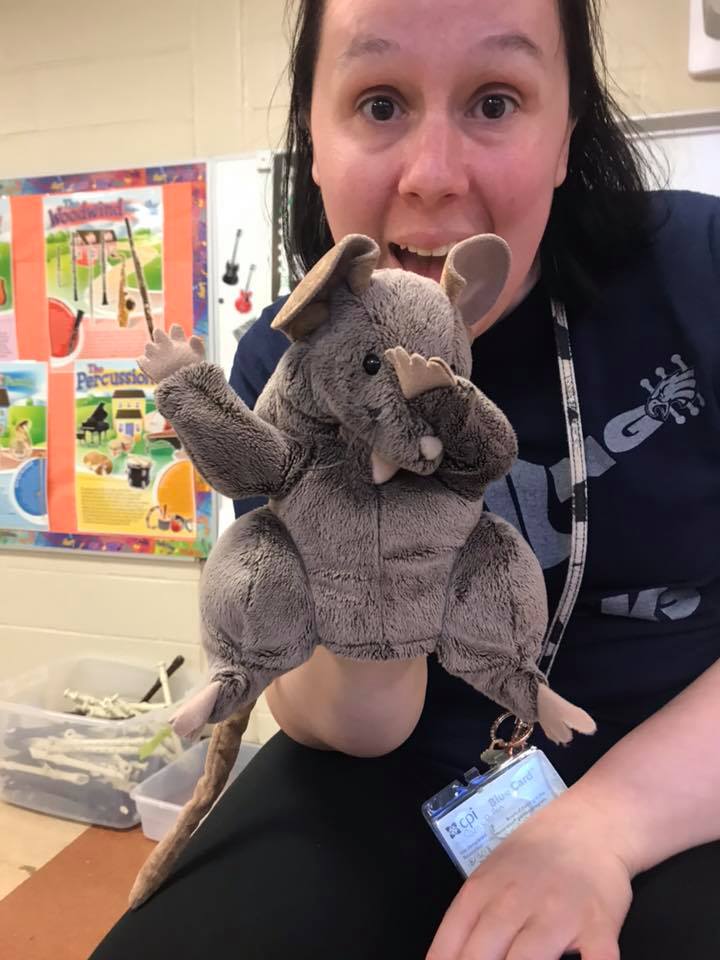
My favorite puppet is a mouse puppet made by Folkmanis. I’ve had him for 6 years and my current 5th graders named him “Cheeser” when they were in Kindergarten. It’s just stuck! I prefer puppets with moveable mouths, as I can do syllable movements when the puppets sing or talk. I like Cheeser the most of all my puppets because I can be very expressive with both his mouth, arms, and hands.
For my youngest grades, I use puppets to help teach the Arioso (child-created tunes) Step in the First Steps in Music curriculum. I have my puppet and I take turns creating our made up tunes, demonstrating how to be both tuneful and artful in the process. As the students get older, they get to pick whether or not my puppet and I create fast/slow or happy/sad songs. I like to play up the drama! Questions I always ask my kids after I demonstrate:
- Did the puppet and I use a talking voice or a singing voice? (Singing voice!)
- Did the puppet and I sing the same thing or a different thing? (Different!)
- Did the puppet and I sing at the same time or did we take turns? (Take turns!)
I demonstrate how to do Arioso with the puppet and I for 4 lessons before I have the students take my place. It’s now the puppet and them creating the songs together! I’ve noticed that children tend to do anything for a puppet, as the puppet feels “alive” to the littles. The kids also like giving the puppet a high-five after singing (Cheeser has such high-fiveable little hands!)
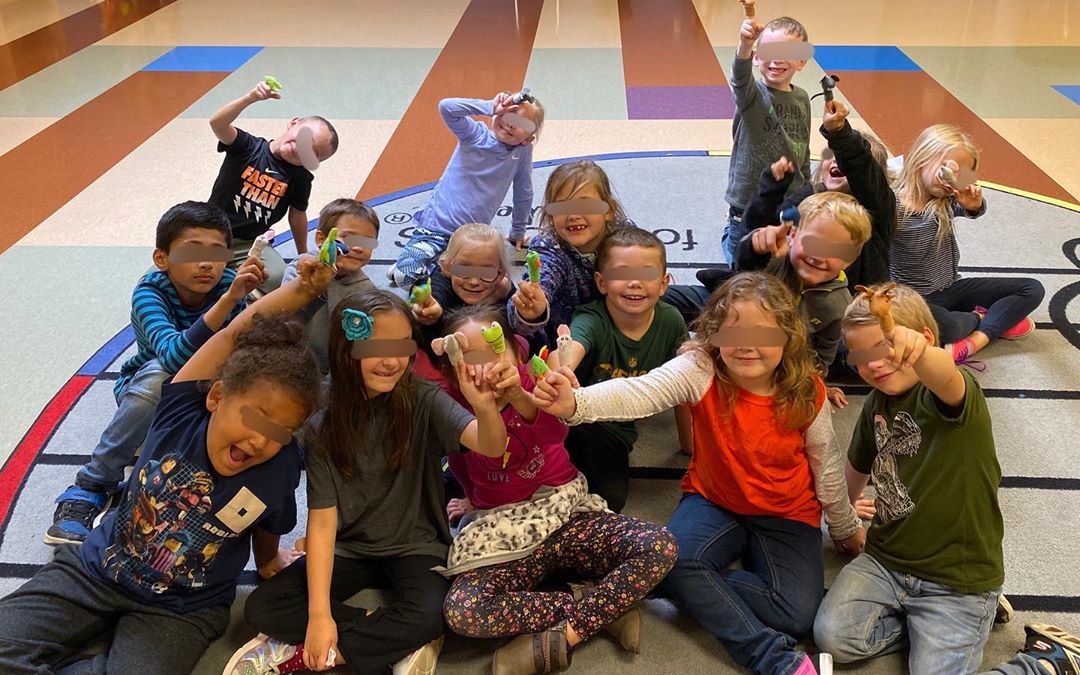
I bought finger puppets at IKEA and have so far used them for my students to do Arioso in pairs. I handed out the finger puppets and my students had to find the student with the same puppet as them as that was their partner. Here’s a particularly tuneful pair in action from one of my First Grade classes!
Another Arioso idea is I like to have a student pick out one of the puppets from my puppet tree and then I have my students sing questions to the puppet. Each puppet has their own personality. My seal only replies in varying styles of the word “Ort!”; my chicken will only “bock!” back; the cheerleader is very bubbly and outgoing; the chef a-talksa-likea-an-Italiana-mana and likes to do chef’s kisses with his hands; and the fox, Ferdinand T. Fox, will answer in an English accent.
Another great use of puppets is to demonstrate “Call and Response” type songs, where the teacher sings the “Call” and the class sings something different from the teacher, known as the “Response”. Sometimes my kids will follow the puppets cues and sing “with” the puppet during the response. I also used them to demonstrate Step 5 in Conversational Solfege with my older students, where they have to say a different rhythm than I do.
I sometimes use puppets as motivational tools:
- The puppet is the audience to their music-making
- The puppet is looking for students making good choices
- The students get to “pet” the puppet if everyone lines up with correct procedures
My favorite brand of puppets by far is Folkmanis. Their animals are extremely realistic and the quality can’t be beat. I have gotten Folkmanis puppets funded through http://www.donorschoose.org or use a bit of my budget if I have some to spare. I’ve recently explored ebay and have found many great deals on new and gently used Folkmanis puppets! I like to search “Folkmanis Hand Puppets” and then sort by Price Low to High.
Let me know in the comments how you use puppets in your classroom or what your favorite puppet is! Stay Tuned for next week, as I will be blogging about giving the Primary Measures in Music Audiation (PMMA) test for the first time! It’s been a doozy!
 Patton The Beat
I love how you took something you are passionate about and incorporated it into your classroom. I’m sure this makes learning a lot more fun and engaging for your students, especially for the younger ones. It’s also really cool that you not only have multiple class puppets but you have a classroom set of finger puppets for student to use. I’m sure this is very motivating for your students and when in use, I’m sure there is a lot more participation and engagement in the lesson. I also love how you have different types of puppets with different personalities. That’s very fun! Any suggestions on how a classroom teacher could incorporate puppets into their classroom? Also, what grades do you use the puppets with? I have never used puppets before. I teach third grade and I’m not sure how they would respond to them. Thanks for sharing!
LikeLike
Kylie,
Thank you for your comment! I use puppets primarily with K-2, however I get them out with the older kids sometimes and they still love them! I get requests from grades 3-5 for the puppets time to time! I forget that the older kids respond well to the puppets as well and that I should utilize them more with them. I use puppets with my older kids to explain more complex concepts, such as call and response singing or improvisation. Sometimes if I have a puppet that goes along with a song or activity, I get that out. I have some music pizza worksheets and will get out the chef puppet, which the older kids find highly entertaining. We use our chicken puppet when we play the game “Chicken on a Fence Post”. I’ve used a simple ghost hand puppet for vocal warm-ups that the older kids enjoyed- they thought it was a cute little ghost. I wonder if you used a puppet during read aloud how the kids would respond. Or, if you are doing a science lesson involving animals, if the kids would enjoy that. Basically, you want to give them quirky personalities and let the kids interact with them somehow, even if it’s the kids asking the puppet a question. Or perhaps your students could use the puppet to present their work to the class, which could be a good motivator for kids to get up and present. It takes the pressure off the kid and the class concentrates on the puppet instead of them. If you use puppets, let me know how it goes! I’d be excited to hear about it!
LikeLike